I will not be accepting new students to our research group for the 2026-2027 year.
Introduction
I am often looking for new additions to our research group who are altruistic, creative, motivated, and sharp, and who have a sense of humor. Training graduate students has been a central focus of my career, and I find it to be the most challenging and rewarding aspect of the job. Currently, our research group is comprised of a great group of young ecologists with a diversity of interests, backgrounds, and skill sets, which affords me the enviable position of learning from my students while simultaneously mentoring them (mutualisms = good). Projects in our research group are centered on two major themes:
-
Some aspect of community ecology (particularly trophic interactions and community assembly), sometimes with implications for conservation or wildlife management.
-
Some aspect of conservation or wildlife management rooted in ecological concepts.
While my own research programs have focused largely on the ecology and conservation of mammals, the study organism is less important than the question or concept being addressed.
Mentoring Philosophy
I’m no stranger to analogies, and an analogy is perhaps appropriate here. With one of the tightest and most talented backing bands of all time, James Brown (the musician, not the ecologist or Cleveland running back) often would exact fines from band members who played sloppily—he would actually do this onstage! James’ rationale was simple: playing music professionally is something many people can only dream of, so the fortunate few who are paid to play music ought to do so with dedication and passion.
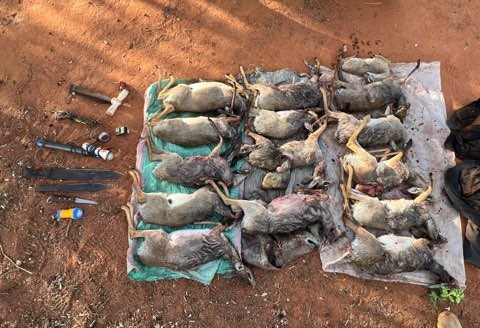
This is not to say that I will fine you for, say, not trapping sufficient numbers of Lepus saxatilis or not being a whizbanger in Python. But it is to say that James’ overarching mentality about musical performance applies to graduate school: the world is your oyster. It is a privilege to be able to think about how nature works, to implement studies to disentangle its complexity, and to spend time working outdoors on wonderful critters in magnificent settings. Just like professional musicians, athletes, artists, and a whole slew of other professionals holding jobs that most members of society would deem fun, ecologists need to be very good at what they do in order to keep doing it. And this is critical: you must absolutely love what you are doing!
While philosophies on graduate advising are almost as numerous as graduate advisors (please see the writings below for three well-known opinions), I think the single universality is just that: graduate school is work, but it should be fun too.
Stearns.
Huey.
Thompson.
There is a caveat to these readings: there are as many pathways to attain graduate degrees and be “successful” as there are graduate students. This is because the definition of success depends on your professional aspirations.
A few words on confidence issues in graduate school. Most folks realize that too much confidence is not a good thing, but too little confidence can be paralyzing. We all have blind spots, so it's imperative to not only be our own toughest critics, but to solicit (and even welcome) constructive criticism. It's key to have the confidence to try things (a field experiment, a particular analysis, etc), even when those "things" might not work out. What may appear to be failures often are opportunities for growth to be embraced.
What You Can Expect From Me
My primary responsibility is to maximize your chances for professional success, where “professional success” is (again) defined by you, the graduate student. As such, it will help if you communicate to me what you envision yourself doing professionally. Goals change, and that’s fine, but it helps to start a journey when you can envision its end. I have a stake in your future, and I treat this obligation very seriously. So, I will tailor my mentoring to your needs to the best of my ability. Regardless of the nuances of our student-advisor relationship, I will always:
-
provide financial support (stipend, travel, research funding, etc) whenever I can.
-
provide logistical support (permits, field vehicles, research assistants, etc) whenever I can.
-
assist with the design and implementation of your research. For MSc students, I anticipate playing a more active role, especially up front. For PhD students, I’m more of a guide in helping you achieve scientific autonomy.
-
proofread manuscripts, grant proposals, and presentations in a timely fashion.
-
meet with you regularly to discuss particulars of your research, other aspects of ecology, or just life in general.
-
lead group meetings for informal presentations and paper discussions.
-
hold you to the highest of standards while simultaneously dissuading you from being a perfectionist. Nothing is perfect, and field ecology is particularly poorly-suited toward perfectionism, which typically manifests as procrastination.
-
be honest and frank with you.
What I Will Expect From You
To my mind, the biggest challenge of graduate education is learning how to think independently. Many of us are conditioned from our previous education to give answers (rather than ask questions), so the transition from passive to active learning often is a combination of anxiety and fun that involves trial-and-error, patience, courage, and lots of hard work. Ultimately, graduate students must take intellectual ownership of their research and broader education. Although your success is very important to me, it will never be more important to me than it should be to you. This means that I expect you to:
-
write manuscripts for peer-reviewed journals, and identify and apply for sources of funding when they arise. Both are critical steps in one’s matriculation as an independent scientist.
-
delve into the literature to understand the precedents and knowledge gaps surrounding the specifics of your chosen project.
-
learn to distinguish between when you need my help versus when you don’t need my help.
-
update me as to your progress 1-2 times per month. One of the most discomforting thoughts an advisor can have is “what has my student been doing with his/her time, and his/her/my grant money?”.
-
take initiative and recognize opportunities when they come your way. Invoke the phrase “I’m too busy” (and its many variants) sparingly.
-
be responsible for your own coursework, research permits, annual reports, degree requirements, filing reimbursement receipts, and the like.
-
communicate to me if I can do something better as your advisor.
-
solicit professional advice regularly and, at least occassionally, follow it.
-
set realistic deadlines for yourself, and meet them most of the time. A friend of a friend of mine has some good advice: always be finishing something. Simply getting things done is a skill every bit as important as writing, quantitative ability, and so forth.
-
enjoy yourself by remembering the reason(s) you got into ecology in the first place.
-
enjoy yourself by having a life outside of ecology, be this through kids, or music, or sports, or art, or whatever.
Contacting Me About Graduate School
I place a premium on analytical skills, writing ability, research experience, hard work, and enthusiasm. If and when you decide to contact me, please take some time and write a thoughtful letter (because this is more likely to generate a thoughtful response). Please send me your CV, GRE test scores and percentages, and transcripts. Tell me a bit about your interests, and why you’re interested in working with our group. Please understand that I may not be able to respond if you don't send these materials. Also, please understand that I may not be able to respond if your interests, experience, or both are mismatched to what our research group does.
Lastly, it bodes well if you’ve looked into a funding source or two, particularly if you’re interested in conducting dissertation work, and particularly if you're interested in working on large mammals. I tend not to accept PhD students who haven’t first earned their MSc degree, but I will consider exceptional cases. If you are interested in forgoing an MSc and working toward your PhD, I will require some evidence of your ability to see something through from start to finish, preferably in the form of one or more peer-reviewed publications.
If you’re still interested working with us after this tome, please send me an email (jgoheen[at]iastate[dot]edu). I look forward to hearing from you!